
ABOUT // WHY WE EXIST
We don't sell tools. We build the system.
RAVARO exists because most companies don't have a tool problem — they have a system problem. Marketing, recruiting, AI, websites: everyone owns tools, nobody owns the architecture. We do.
Founder
Ralph Appel
Ralph Appel comes from process optimisation — years inside the competence centre for complaint management at Deutsche Telekom, followed by process work in automotive. The pattern was always the same: strong companies, strong teams, and the real gains were never in a new tool. They were in the architecture between the tools. RAVARO is that lesson, turned into a product.
"An operating system beats a stack of tools every single time — because the system runs when nobody is watching."
/// CAREER RECORD
Ralph A. Appel — twenty years of finding out why things break.
RAVARO does not sell campaigns because of a marketing opinion. It sells systems because of where I spent the last two decades: inside companies, being handed the problems that everyone else had already failed to solve.
Deutsche Telekom, Augsburg
I helped build the competence centre for complaint management — the first of its kind in this form in Germany, a pilot for the whole organisation. We didn't just answer complaints, we built the escalation and handling processes from scratch.
+Read moreLess
My work sat at the end of the line: the cases that had already been through everyone else, including complaints addressed to the board. Almost none of them were caused by a bad employee. They were caused by a process nobody had designed. The formal name for that part of my job was “analysis of systemic sources of error”. I did not yet know I would still be doing it twenty years later.
Sales, M-net and Rebound Electronics
Business telecommunications: from connectivity through to dark fibre — long sales cycles, technical buyers, decisions made by committees. At Rebound Electronics, contract distribution, margin optimisation and end-of-life management for components.
+Read moreLess
Years of B2B selling teach one thing that no marketing course does: what a buyer actually says when they are close to deciding, and what they say when they are only being polite.
MBA, Management & Communications, FH Vienna
Taken alongside the job — and, unexpectedly, where the marketing half of RAVARO comes from.
+Read moreLess
I went in expecting management theory. What the programme actually had was marketing lecturers who had built the campaigns they were teaching. One of them had created the talking sandwich for Subway, and instead of showing us the finished ad he took the whole campaign apart: what it was supposed to do, who it was aimed at, why every single piece was there at all. That was the first time I saw a campaign as a construction rather than an idea.
He was also where I first heard about Fiverr. At that point almost nobody in Germany had. The lesson turned out to have little to do with the platform and everything to do with where you are looking.
Part of the programme ran in Dublin, organised in a way I have never forgotten: nobody arranged the company visits for us. Each of us had to get through the door alone, ask for the marketing team, and come back with what they actually did all day. Some doors stayed shut. That is a better sales education than any seminar.
My thesis was on motivation potential analysis and its effect on sales — a questionnaire built to work out which personality traits predict how a person decides to buy, and what that means for the way you should talk to them. Complicated, uncomfortable in places, and the reason I have never believed in one message for everybody.
Mercedes-AMG
I was brought in on the strength of the Six Sigma Black Belt, to optimise the competence team — the upstream unit behind every Mercedes-AMG project. Every department, from interior through to electronics, has a KT manager plus a KT assistant. The brief: analyse the processes and find out where the dissatisfaction among the staff was coming from.
+Read moreLess
Standard current-state analysis, causes sorted with Ishikawa, then a defined set of changes.
Two of those changes I built myself. Software for the competence-team meetings, so that each participant was invited only to the topics that concerned them and every topic came back with a follow-up. And a ticket system that put the supplier and the OEM into one conversation instead of two mailboxes.
From there: competence-team assistant, then project lead for the steering wheel module — parts availability, milestones, suppliers, escalation, budget, up to board-level committees. I was also part of the development side of the steering wheel itself; I took them apart, and I saw quickly where large amounts of money disappear.
In one of those rooms I contradicted Tobias Moers, then CEO of Mercedes-AMG, three or four times on a technical point — until he said: you are the expert, you know this better than I do. That sentence is the whole job. You are not paid to agree with the person who hired you. You are paid to be right about the thing you were brought in to know.
The assignment was planned for three months. It lasted three years. Years later I returned to the same role at Autoliv, for Daimler/AMG.
What that taught me, and it is the reason RAVARO works the way it does
In process optimisation the hardest problem is never the process. It is the person. People's comfort zone is large enough that when you take work off them, the first thing they see is more work — and nothing else. A system that is technically correct and ignores that will not be used, and an unused system is worth nothing.
So we do not hand over a system and call it delivered. We build it so that the first week is easier than the week before it.
Lean Six Sigma Black Belt
DMAIC, value stream mapping, FMEA, statistical process control. Not a certificate for the wall — it is the reason I look at a company the way I do: find the bottleneck, measure it, then fix the cause instead of the symptom.
M Plan
Recruiting and project management for automotive clients, staffing technical specialists for OEMs and tier-1 suppliers. This is where I filled the positions people had written off as unfillable — not with a better job ad, but with a process: what the role actually needs, who actually fits, and a sequence that doesn't lose the candidate in week three.
The decision
During the pandemic the question became simple: if not now, when. I went out on my own, and I invested heavily in learning the field properly — around €80,000 in training at that point, most of it from the US, because in performance marketing they are years ahead of Germany. Email marketing, social, affiliate, funnel building, recruiting funnels.
+Read moreLess
And then I did what most agencies never do: I stopped selling everything. I had been doing all of it — flyers, banners, whatever was asked for. RAVARO exists because I cut that down to the work that actually compounds.
The same gap, in every company
In every company I walk into, the picture is the same regardless of size or industry. Nobody has a marketing problem. Nobody has a recruiting problem. They have tools — a CRM here, a job board there, an agency somewhere — and nothing that connects them. They work hard and lose money in the gaps.
Which is the same thing I was looking at in Augsburg in 2010.
/// HOW WE WORK
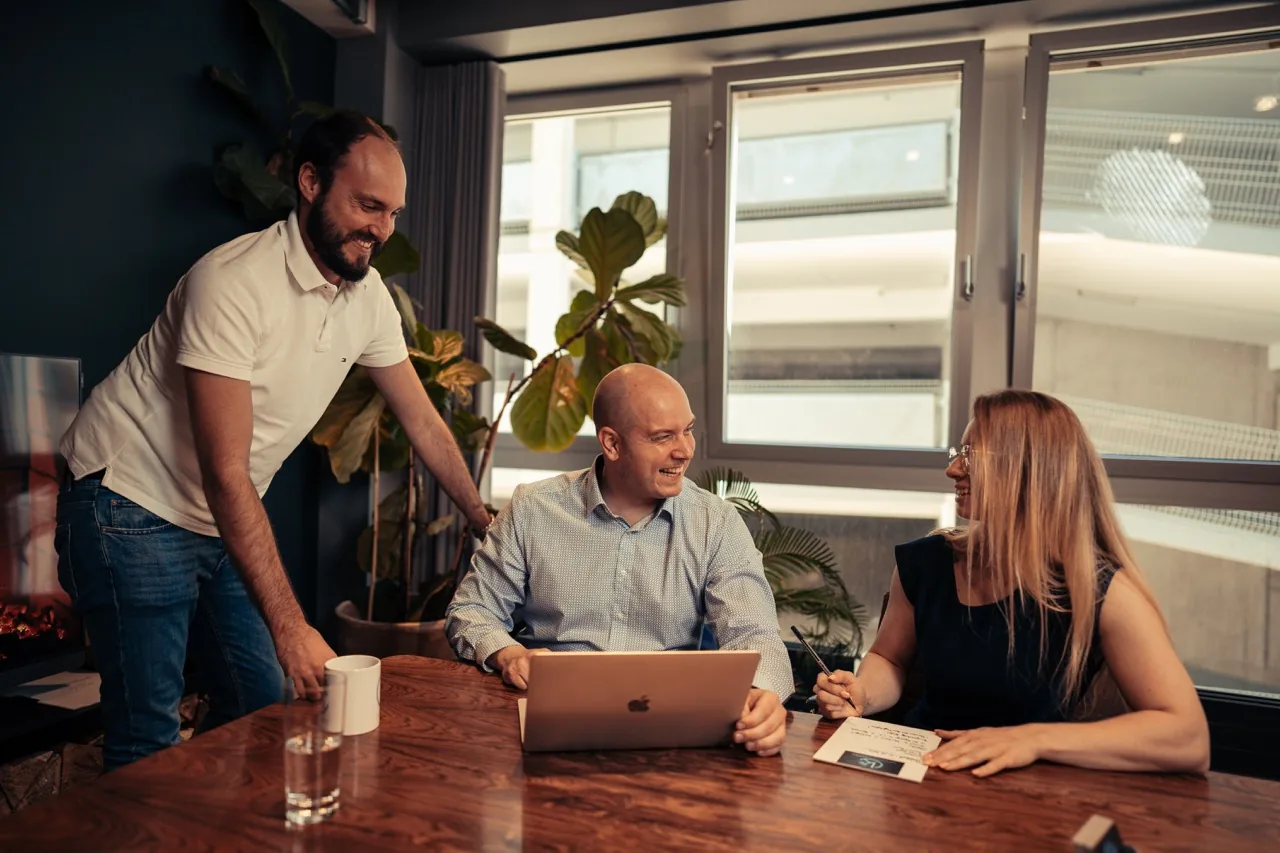
Before we build anything we ask what a company actually wants to sell — which is rarely what its website says. Twenty percent of clients usually produce eighty percent of the revenue, and the interesting question is whether that is the work you want more of. Then we build the path that brings it in, including what happens after the enquiry arrives.