
Build the Recruiting Process — and Launch the Recruiting Campaign Only Afterward

A position has been open for weeks. You ran an ad, a few applications came in, two of them looked promising — and one of the two never responded again after the first phone call. Now a recruiting campaign is supposed to fix that.
It can. But advertising generates applications, not a process. If an application sits in your inbox for five days, you're paying your campaign budget to make more people drop out. The bottleneck rarely sits in the ad — it sits in what happens afterward.
This article walks through the recruiting process in six stages, shows the order in which a campaign makes sense, and gives you the numbers to read off your own bottleneck.
The Recruiting Process in Six Stages
A recruiting process is the path from first contact to the end of the probationary period. At every stage, things can fall apart. As you read, take your most recent open position and note where things get stuck for you.
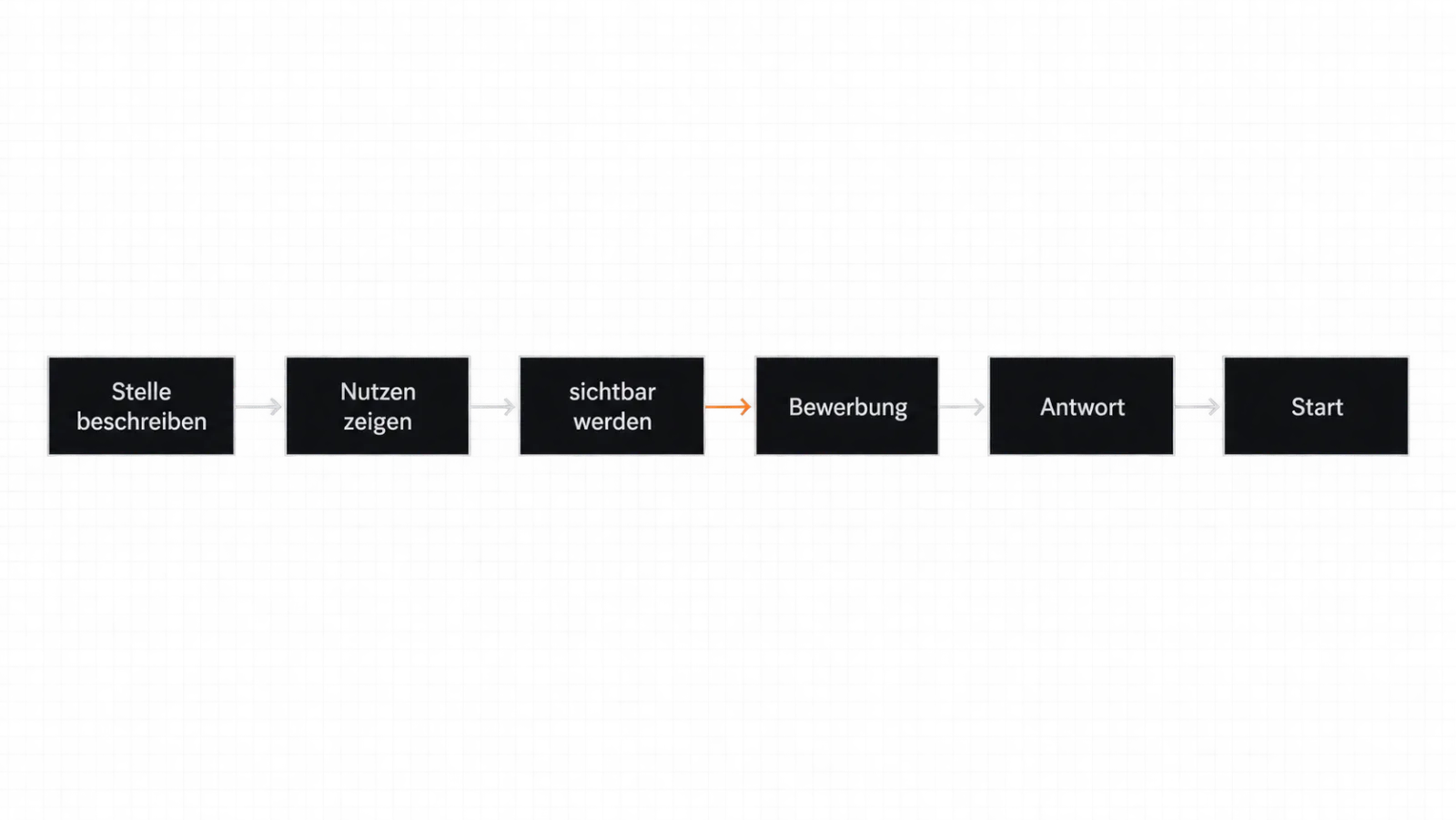
1. Describe the Job the Way It Really Is
Most job ads describe an ideal candidate: team player, resilient, self-motivated. That reads the same at every company, and it tells no one what the job actually looks like.
Instead, write down what the person will actually do in the first week. Which tasks fill the day, which come up only rarely? Who sits next to them, who gives instructions, when does the shift start and end? What will they work with — which machines, which vehicles, which software?
The test: Could a competitor take your ad and just swap out the company name? Then it says nothing about what makes you different.
2. Say What's In It for the Candidate
A good tradesperson, a good caregiver, a good dispatcher most likely already has a job. That person only switches if they can see what will be better with you.
So: state a salary range. Say how the shifts are scheduled and how often overtime comes up. Describe what's possible after two years. If you have things that others lack — fixed end-of-shift times, a new vehicle, paid training — they belong near the top, not buried at the end in a bullet-point checklist.
Where you're weak, say so. Someone who only learns about the night shift in the interview will back out. Someone who reads about it in the ad and applies anyway will stay.
3. Getting Visible: Job Board or Recruiting Campaign
The two paths reach different people.
- Job boards and career sites: People who are actively searching land here. They compare several ads side by side, and they compare fast. This is cheap to get, but it limits your pool to people already on the market.
- Recruiting campaign via social media ads: Here you reach people who aren't searching. They're scrolling on the couch in the evening and see how work looks at your company. These people don't respond to an ad — they react to an impression, which is why this path needs real footage from your actual operation and a very short application path.
If nobody has responded to your job board listing in months, the market in your region has probably been searched dry. In that case, a campaign helps. If applications come in and then stall in the process, it doesn't.
4. Make Applying as Easy as Sending a Message
Cover letter, resume as a PDF, certificates, plus a form with seventeen required fields on a phone: this is where most people give up. A technician clicking your ad at half past ten at night doesn't have a resume on their phone.
At first, only ask for what you need to decide on a phone call — name, contact details, two or three qualification questions. You can request documents later, once both sides have shown interest. The form must be fillable on a phone in under three minutes, and the applicant must see immediately that it went through.
5. Respond Within Hours
This is where companies lose the most good candidates, and fixing it costs nothing.
Candidates rarely apply to just one company. Whoever responds the same day gets to speak with the candidate first. Whoever takes a week often doesn't get to speak with anyone at all.
Three things make this workable day to day: An automatic confirmation of receipt that says when a person will follow up. A fixed point of contact who's reachable even when the boss is out on a job site. And a scheduling link that lets the applicant pick an interview slot from your open times themselves, instead of two failed callback attempts.
6. Interview, Offer, and the First Week
Keep the first conversation short and over the phone. Fifteen minutes is enough to clarify whether it's a fit; the rest gets clarified during a visit to the workplace, where the person sees the job site and their future colleagues.
After the offer, the second dangerous phase begins. Weeks often pass between the offer and the first day of work, during which the old employer makes a counteroffer. Stay in touch during this time: get the contract out quickly, check in once in between, and send the plan for the first day a few days ahead.
And then the first day itself. Work clothes are ready, access is set up, someone is assigned as a fixed point of contact. Someone who stands in the hallway for twenty minutes on their first morning will remember that longer than they'll remember your ad.
Launching the Recruiting Campaign: The Order That Saves Budget
A campaign amplifies whatever's already there — including the gaps. Hence this order:
- Stages 4 and 5 come first. A short application form, an automatic confirmation, one person responsible for responses. No ad goes live before that.
- One position, one target audience, one region. Two roles in one campaign dilute both, and you won't learn what actually worked.
- A dedicated page for the position. The ad leads to a page with real footage from your operation and the form right below it — not to a PDF, and not to your general careers page.
- Real footage instead of stock photos. A phone video from the shop floor, where the foreman spends thirty seconds explaining who they're looking for, beats any stock photo.
- Start small and watch the numbers. The first few days show whether clicks come in, whether forms get submitted, and whether the applicants fit the role.
- Only scale up once interviews are actually happening. Not based on a high number of applications — based on appointments that actually take place.
The most common expensive mistake: the campaign keeps running while applications sit unprocessed in the inbox. If you can't respond for a week, pause the ads.
Five Numbers That Show Your Bottleneck
You don't need a report with twenty metrics. These five transitions are enough to see where your process is losing people:
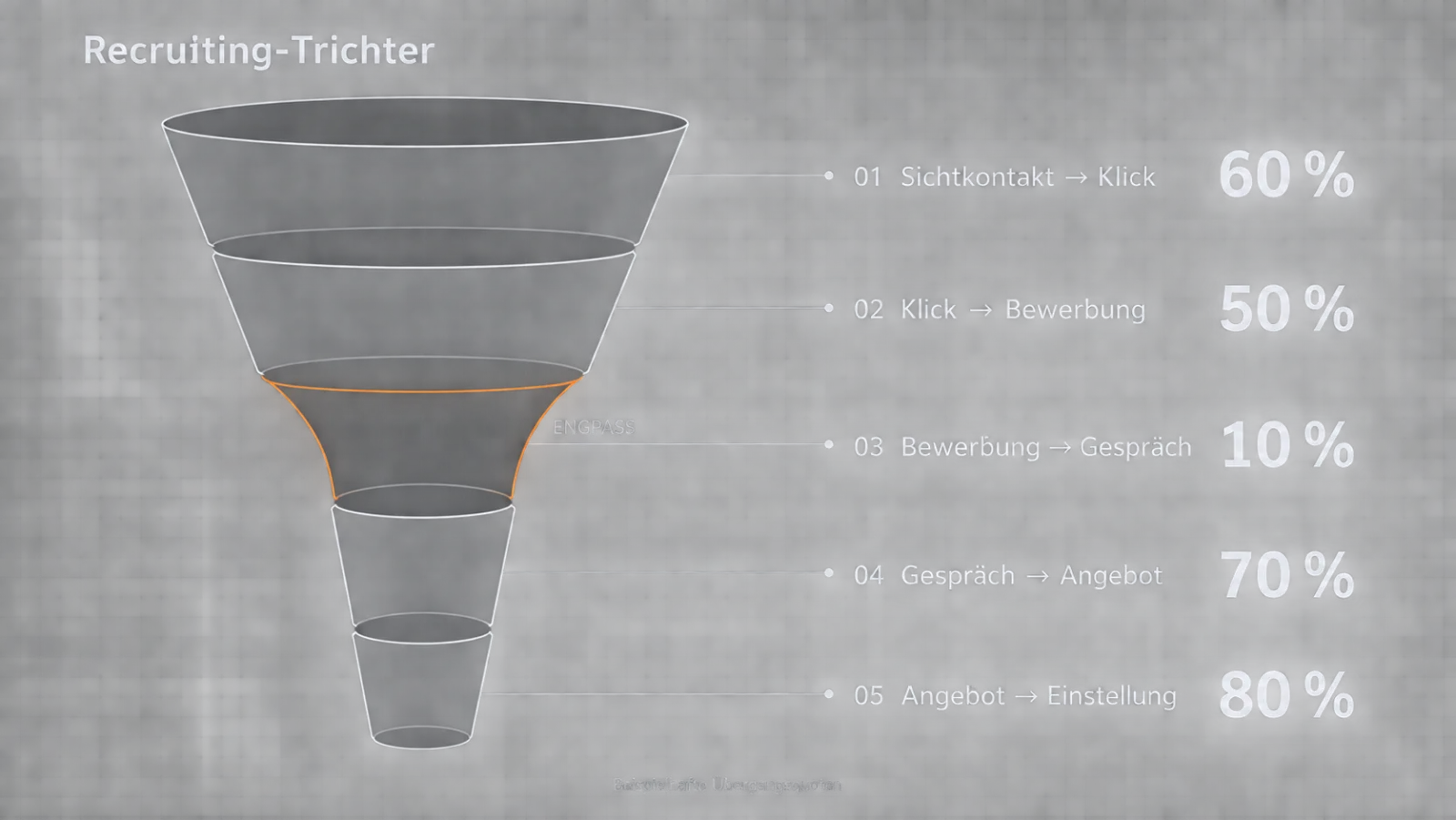
- Ad click → form opened. If this drops off, the ad is promising something different than the page delivers.
- Form opened → application submitted. The classic drop-off point: too many fields, a required upload, unusable on a phone.
- Application → first response, measured in hours. Measure this honestly — from receipt to a real phone call, not to the automatic email.
- Response → scheduled appointment. If this drops off, you're not reaching people, or the back-and-forth over scheduling is taking too long.
- Offer → first day of work. Losing people here isn't a candidate problem — it's too much radio silence before the start date.
Whichever number drops the most is your bottleneck. Work on that one, and leave the rest as it is for now.
Build It Yourself, or Have It Built
You can build all of this yourself. Form, confirmation email, scheduling link, and a list where you can see every applicant and their status — that's an afternoon of work per building block, if you know which tools to connect. The effort lies less in building it than in maintaining it: someone has to manage the ads, keep response times up, and keep an eye on the five numbers.
That's exactly what RAVARO builds as a connected system — Recruiting OS: ad, applicant page, short form, automatic response, appointment booking, and the overview where you track every applicant from intake to their first day. For Milestone (apparel, e-commerce), this approach brought in 160 qualified applicants in 12 weeks, filling 8 positions.
How much needs to be built for you depends on how much process is already in place. We'll figure out what your case needs in an initial call — bring along which of the six stages already work for you and which number from the list above drops the most.
Request an initial call — or take a look first at what other systems RAVARO builds.
Want us to look at your company as a system?
Twenty to thirty minutes. No pitch deck. A clear recommendation at the end.
Free analysis