
CASE /// EXPERIENCE QUARTER · CONCEPT
1516 | 1776 | 1818 Ingolstadt
Concept by RAVAROCONCEPT BY RAVARO · EXPERIENCE QUARTER · INGOLSTADT
Three stories. One place. Where taste meets goosebumps.
How it started
Sometimes a big idea does not start on a drawing board. It starts with a building. With an old tower.
Concretely: the former Bäumler site in Ingolstadt. It has lain fallow for years — a levelled plot behind construction fencing, right in the middle of the city. What remains is the tower.
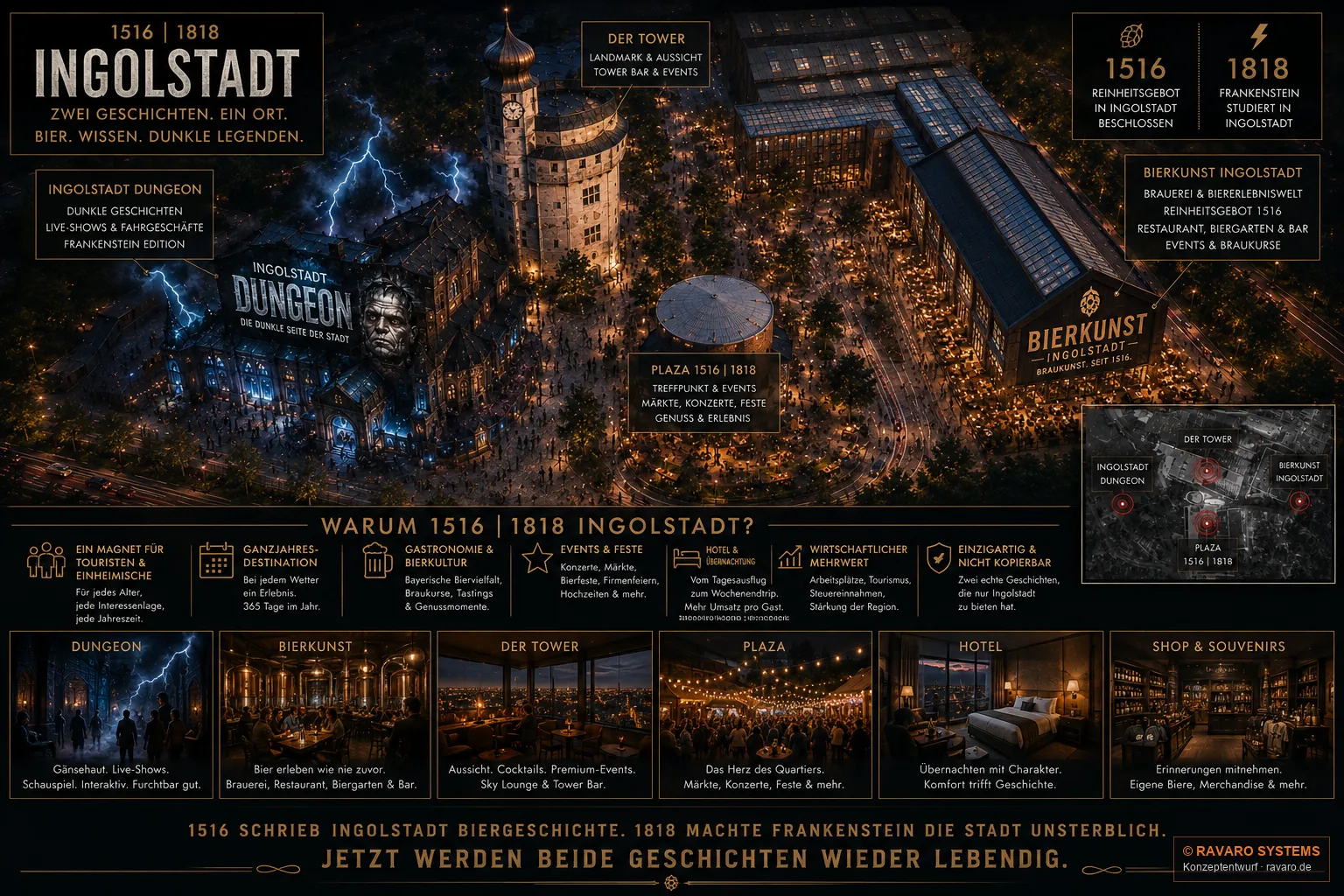
From a first look at the site, the idea of a new experience quarter grew step by step — one that connects gastronomy, tourism, entertainment, history, hospitality and events.
Not as a historical museum. Not as another leisure offer. And not as another restaurant floor.
The question everything grew from
What could be built here if you do not simply redevelop the place — but give it a story?
Ingolstadt owns two stories almost no other city can claim. Both are told. Neither is experienced. That is where the concept starts.
“The strongest story a place has is the one you do not need to invent.”
1516 trifft 1776 trifft 1818
The core of the idea is already in the name.
1516 stands for beer culture, the purity law, craft and pleasure. 1818 stands for Frankenstein, science, the university, experiment and dark fascination.
Two entirely different worlds — and that contrast is what carries the idea. Between them lies a third date that connects both: 1776, the founding of the Illuminati at the same university. On one side warmth, fire, copper, beer, food, company. On the other darkness, thunderstorms, science, goosebumps.
The landmark of the entire quarter.
And right between them stands the historical tower.
How the idea became a quarter
It began with the question of how the existing site — and the tower in particular — could be staged properly. It was quickly clear: the tower should not disappear, and it should not be a decorative leftover either. It should become the centre.
From there the basic structure emerged:
The dark side of the city.
The landmark that connects both worlds.
The heart between the worlds.
Brewing craft since 1516.
A visit becomes a weekend.
One decisive thought came later: if people travel to Ingolstadt for this experience, why should they leave again after a few hours?
That turned a leisure concept into the idea of a real destination.
One guest. Many experiences.
One of the concept's greatest strengths is that the areas do not have to work in isolation. They can feed each other visitors.
Whoever comes for Frankenstein discovers the brewery. Whoever comes to eat sees the tower. Whoever attends a company event gets to know the dungeon. Whoever stays the night spends more time in the restaurants and in town.
That creates a chain rather than a single attraction: entertainment → gastronomy → events → hospitality → retail → tourism. One visit turns into several touchpoints — and several touchpoints can turn into a whole stay.
1776 — the third thread
Between 1516 and 1818 lies a date that ties the two together: 1776. That year, Adam Weishaupt, professor of canon law at the University of Ingolstadt, founded the Order of the Illuminati — at first with a small group of his own students, himself under the cover name Spartacus.
This is not a myth, it is city history. In 1782 the order established a Minerval church; on 22 June 1784 Elector Karl Theodor issued his mandate against secret societies; in 1790 the explicit ban followed. Weishaupt fled the city in 1785. At Theresienstraße 23 there is still a hall known as the Illuminati hall.
For the concept this is more than a third date. It is the link: the same university where a secret order was founded in 1776 is where Mary Shelley has her Victor Frankenstein study in 1818. The invented story gains a true foundation — and a secret order with cover names, degrees and a ban by the Elector belongs in the dungeon, not in a display case.
Source for the dates: Stadtgeschichtslexikon of the City of Ingolstadt.
Ingolstadt Dungeon
Frankenstein is not exhibited. Frankenstein is experienced.
The dungeon is conceived as an immersive world in which visitors are drawn into a darker version of the story through live acting, sets, light, sound, special effects and interactive elements. You do not enter an exhibition room, you enter a story: university, anatomy, experiments, dark corridors, thunderstorms, electricity — and finally Frankenstein's laboratory.
Frankenstein is the emotional climax. Before it lies a chapter that needs no invention at all: the Order of the Illuminati — secret society, cover names, degrees, a ban by the Elector, the founder's flight. What emerges is not a static exhibition but an attraction whose darkest parts actually happened. History should not sit behind glass here. It should suddenly stand right in front of you.
Bierkunst Ingolstadt
On the other side of the quarter, the deliberate counterpart takes shape: warm, alive, sociable.
Bierkunst Ingolstadt is conceived as a mix of modern brewery, restaurant and beer experience. Visitors should not simply order beer — they should see, smell, taste and understand how it becomes a piece of culture. Conceivable are a show brewery with open production, a world around the purity law, a beer lab and tastings, brewing courses, restaurant, bar and beer garden, rotating specialities and, explicitly, Franconian beer.
Add events, company celebrations, beer festivals, guest brewers, seasonal editions and a shop of its own. That would make it no ordinary brewery restaurant, but stage, workshop, restaurant and experience at once.
The Tower
The tower belongs neither exclusively to the dungeon nor exclusively to the brewery. It connects both worlds.
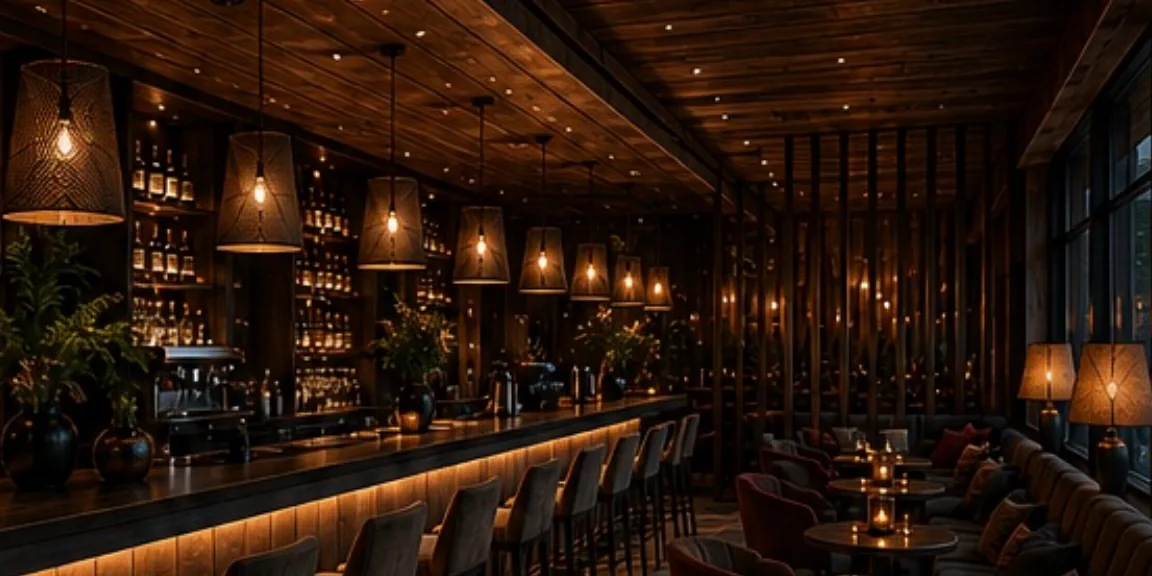
The idea is a vertical journey: reception and historical elements at the bottom, above them a short time travel from 1516 through 1818 into the present. Further levels could hold a tower bar with character, private dining and a secret room. Above that the sky lounge — and at the very top the viewing platform over Ingolstadt.
A sight by day. A bar and meeting point in the evening. A glowing landmark at night. The tower would not just be part of the project — it would be its face.
Plaza 1516 | 1818
Between dungeon, tower and brewery, a public square takes shape — but not one you merely cross.
Beer festivals, markets, concerts, food festivals, Christmas markets, open-air events, company celebrations or special Frankenstein Nights could all take place here. In summer you sit outside, in winter the quarter glows, at weekends the tourists come, during the week companies and locals.
That way there is always a new reason to come back.
The Hotel
The hotel is the logical extension. Once dungeon, brewery, tower, events and the old town are connected, something larger than a single attraction emerges: a reason to travel.
Arrive. Experience the dungeon. Eat at the brewery. Have a drink in the tower in the evening. Stay the night. Have breakfast the next morning and discover Ingolstadt.
A three-hour visit can become a two-day stay — and that changes the economics of the entire project.
365 days of experience
One question was there from the start: what happens when it rains? What happens in November? What happens on a Tuesday evening?
The answer lies in the combination. In bad weather the dungeon works. In winter the brewery and the events work. In summer the beer garden and the plaza come alive. In the evening the tower bar and the restaurants work. Company events during the week, leisure guests at the weekend.
A seasonal attraction could become a year-round quarter — and the site would not depend on a single reason to visit.
Possible economic dimension
What follows is neither a forecast nor a feasibility study, but a first plausible order of magnitude — a projection supported by comparative figures from businesses that actually exist.
Ingolstadt already has a usable tourism base: in 2025 the city counted 411,394 arrivals and 658,410 overnight stays, at an average stay of only 1.6 days. Across Bavaria that figure is 2.5 days.
The short stay is exactly what makes this concept interesting: a strong evening, food, entertainment and hotel offer would not only attract additional visitors, it would give existing guests a reason to stay longer.
Dungeon: 35–55 direct jobs, 140,000–220,000 possible visits a year. Bierkunst with restaurant and bar: 45–70 jobs, 180,000–280,000 visits. Brewery, beer experience and shop: 10–18 jobs. Hotel with 80–120 rooms: 25–45 jobs, 35,000–65,000 overnight guests. Tower, sky bar and events: 10–20 jobs, 50,000–90,000 visits. Plaza with events and markets: 8–15 permanent posts plus temporary ones, 80,000–160,000 visits. Plus management, technology, cleaning and security with 15–25 posts.
In total roughly 150–250 direct jobs — head count including part-time and seasonal staff, not full-time equivalents. The visit figures must not be added up: someone who goes to the dungeon may afterwards visit the brewery, the plaza and the tower. For the quarter as a whole, 250,000–400,000 individual visitors a year in established operation is the more realistic figure.
The benchmark: Hamburg Dungeon
The Hamburg Dungeon opened in 2000 and had welcomed more than five million visitors by early 2025. Spread over 25 years that is an order of magnitude of more than 200,000 visits a year — a derivation, not a published annual figure.
The operating model also shows why this is labour-intensive: professional actors, ten different shows, guest services, technology, operations.
For Ingolstadt a conservative view would be 100,000–140,000 in year one, 140,000–180,000 once established, 200,000+ in the success case. The difference to Hamburg is the smaller tourism catchment — what Ingolstadt has instead is a story of Frankenstein, the university, the Illuminati and city history that belongs precisely here.
Bierkunst: Liebesbier × Timberjacks
Not copying either one, but taking the strengths of both mechanics.
Liebesbier in Bayreuth shows how strongly beer experience, brewery, restaurant, hotel and events can work together: 300 indoor seats, more than 100 beers, a direct view into the brewing workshop, plus hotel and event space for up to 200 people. People do not come there only to eat — the place itself is the product. Timberjacks supplies the other half: large, strongly staged experience gastronomy with a character of its own.
Bierkunst Ingolstadt would be the crossing of the two, plus Ingolstadt history: 300–400 seats inside, 200–300 outside, 20–30 taps, an open brewery, Ingolstadt beer, Franconian beer, guest beers, brewing courses, tastings, a large open kitchen, beer garden, events, shop — and the hotel built in above it. That is no longer a pub. It is a tourism anchor.
Liebesbier and Timberjacks are other people's businesses. They stand here as a yardstick, not as our own reference.
Three scenarios — and what they would mean for the city
Conservatively around 200,000–250,000 individual visitors a year. Realistically, as an established destination, 250,000–350,000. In a strong supra-regional success case 350,000–400,000 and more.
For comparison: Ingolstadt currently registers a good 411,000 arrivals per year. The project would therefore not have to generate exclusively new tourists — it can activate residents, day trippers from the region, existing hotel guests, business travellers and event visitors.
The dungeon brings footfall. Bierkunst monetises length of stay. The plaza brings events and free footfall. The tower creates a landmark and a premium product. The hotel extends the stay. Everything feeds guests to everything else — that is the difference between five separate businesses and a destination.
POTENTIAL FOR INGOLSTADT: 250,000–400,000 visitors a year. 150–250 direct jobs, plus indirect employment among suppliers, trades, taxis, cleaning, event partners, regional breweries and retail. 365 days of experience.
A first conceptual projection; not a reliable visitor, employment or profitability forecast.
Why Ingolstadt of all places
The concept does not try to bring some arbitrary experience world to Ingolstadt. It turns the logic around: what does Ingolstadt already own — and what could be built from it that people genuinely want to experience?
Other cities can build a brewery. Other cities can build a horror attraction. Other cities can put a hotel next to an event venue. But three stories in one place — the purity law of 1516, the founding of the Illuminati in 1776 and Frankenstein in 1818, two of them at the same university — no one else has. That is what makes the combination hard to copy.
Beyond the attractions, new reasons to visit, longer stays, food and lodging, jobs, corporate events and cooperation with regional breweries all become conceivable — and above all a new image of the city. Not only automotive, not only historical buildings, but a city that takes its own story and builds something new from it.
How we worked
The concept deliberately did not start by filling buildings with uses. We worked the other way around: the story came first.
What makes this location special? Which themes genuinely belong to Ingolstadt? Which contrasts create tension? Which offers give people a reason to come — and which give them a reason to stay?
From those questions the dungeon and the brewery emerged first. Then the tower was developed as the connecting landmark, the plaza created the shared centre, and the hotel turned several attractions into the vision of a complete destination. Only afterwards were the areas worked out visually — from the overall site to the interiors and the vertical use concept of the tower.
This is a concept, not a built project. We developed it on our own initiative; no investor and no city commissioned it. All images are drafts, not photographs. There is no building permit, no cost calculation and no commitment from anyone.
What it does show: how two existing stories of a place can become one connected experience — and how we work when an idea comes before the first floor plan.
A website that only looks nice is dead weight. Website Systems builds a site from your actual business goals — one that takes work off your plate and turns visitors into real enquiries.
All drafts
Jedes Blatt in voller Auflösung — anklicken zum Vergrößern.