
CASE /// INVENTED KITCHEN STUDIO · SHOWCASE
Werrewerk Küchen
Concept by RAVAROInvented example: the kitchen studio doesn't exist, the website does.
What if your customer could stand in their finished kitchen before a single cabinet is built? A kitchen that comes together in a time-lapse, that the visitor restyles with a price, and behind it a business you would trust to build it.
werrewerk-kuechen.vercel.app
Go to the siteBest to restyle a kitchen yourself first, then read on here.
Opens in a new tab
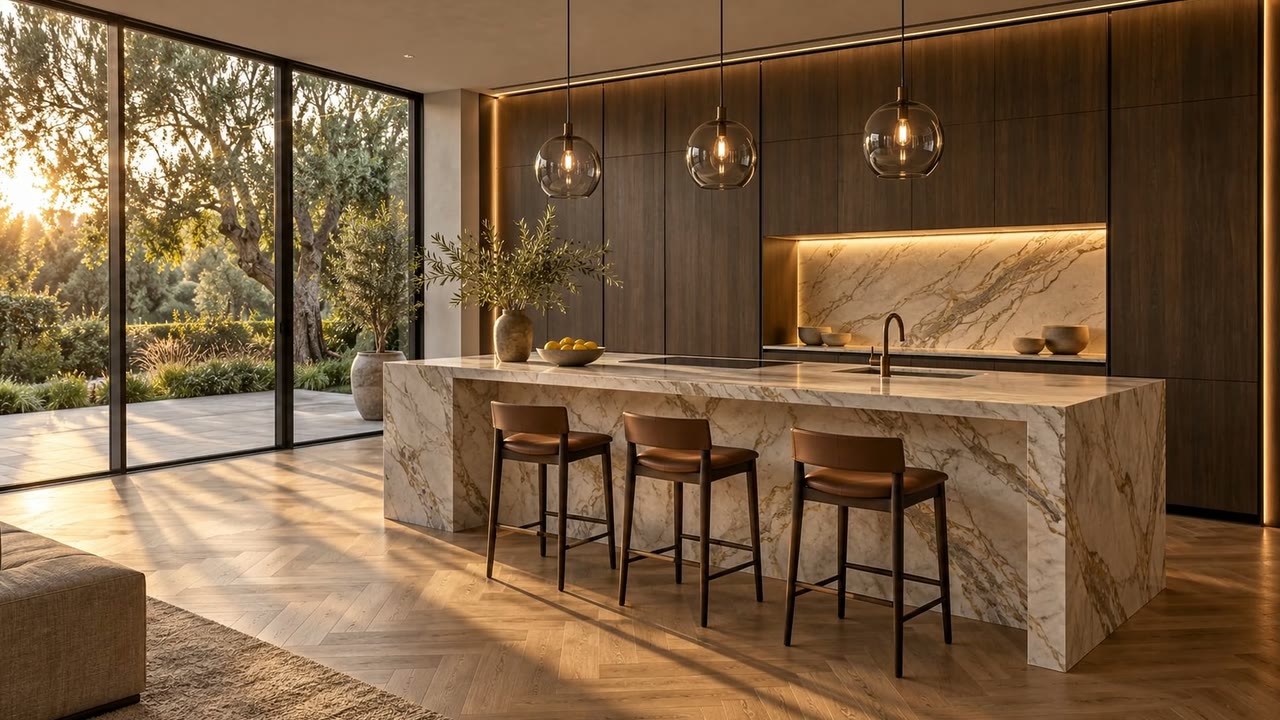
What does a kitchen studio sell?
Not cabinets and not appliances, but the evening you first stand in your finished kitchen. Until then the customer has to piece together a kitchen worth tens of thousands from brochures, a showroom and a floor plan. Most kitchen websites show them photos of other people's kitchens and a contact form.
Nobody ordered this site. It belongs to a series of example sites we build without a client, so that we can show what is possible instead of inventing client results. Werrewerk Küchen from Herford does not exist.
→ So the question was: can a website put the customer into their finished kitchen before it is built?
The kitchen comes together while you watch
The site opens on an empty shell. In ten seconds the floor is laid, the island arrives, the fronts go on, the pendant lights are hung and the lights come on. Then the visitor moves the mouse, and the camera glides around the island like a walk-through.
Why like this: a finished photo says “nice”. A time-lapse says “people build this, step by step”, and it ends in the result you want to own. Our first draft was a paper kitchen clicking itself together. Ralph's verdict: no wow. He was right, because it explained instead of making you want it.
For you: your installation as a time-lapse, your showroom to look around in.
→ And then the site says: your turn.
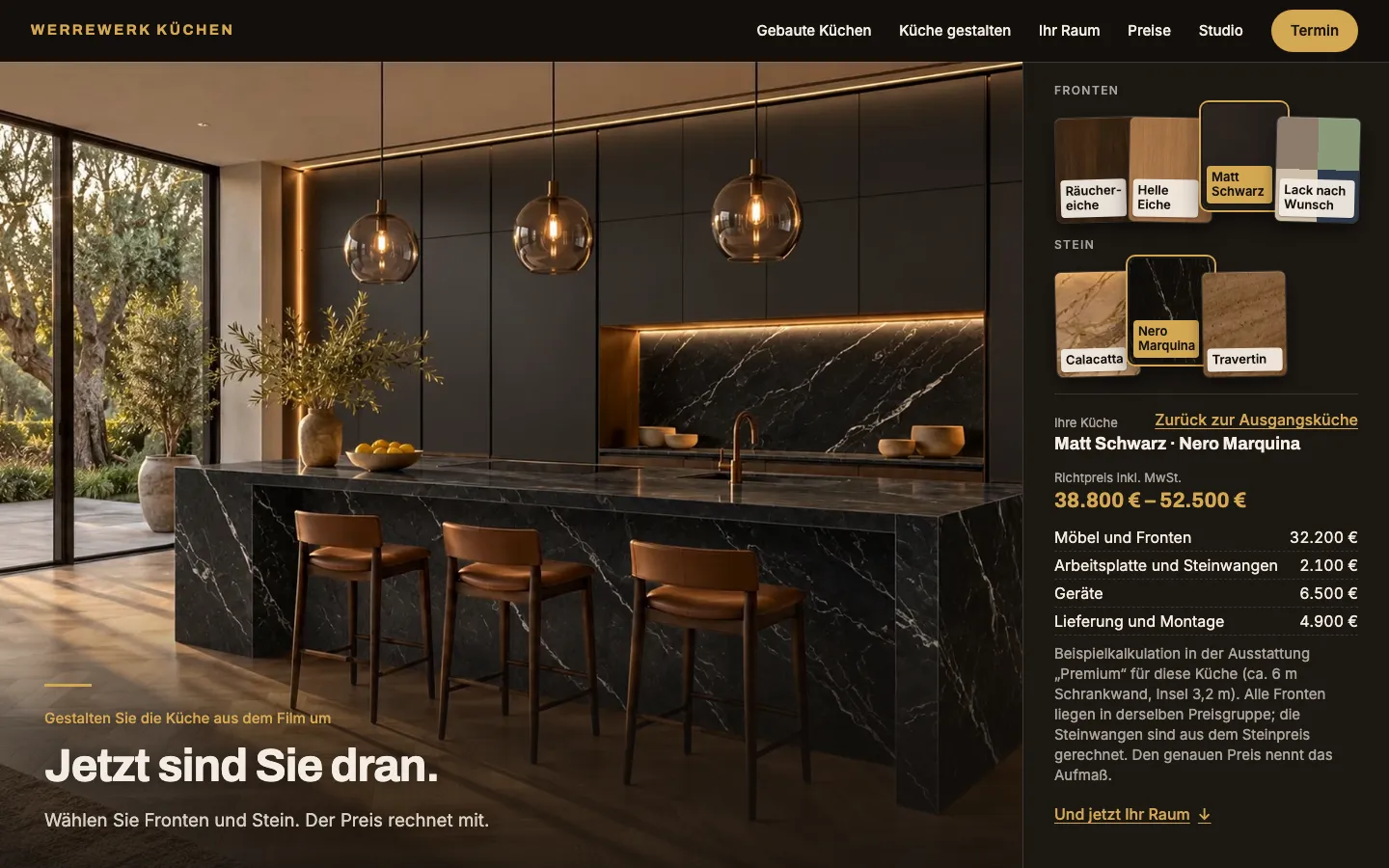
“Your turn.” The visitor restyles the kitchen
The same kitchen from the film, and now the visitor decides: fronts in smoked oak, light oak, matt black or lacquer in any colour, stone in Calacatta, Nero Marquina or travertine. The guide price changes with it, in four lines: cabinets, worktop, appliances, delivery and installation.
At first the colour choice sat right behind the film, one tool among many, and it was easy to scroll past. Ralph, in the role of the owner: designing the kitchen has to move to the front. Since version 0.18 it has its own entrance: a large headline, “Your turn.”, the kitchen changes colour a few times by itself as it scrolls in, and stops at the first tap. Fronts and stone lie there as sample boards, like the sample case at a consultation.
Why like this: whoever has chosen for themselves already owns a kitchen in their head. And the price answers the question that otherwise only comes up on the phone. For you: your fronts, your stones, your price groups.
Whoever taps twice here is already planning their own kitchen.
→ The next question follows on its own: does that fit into my room?
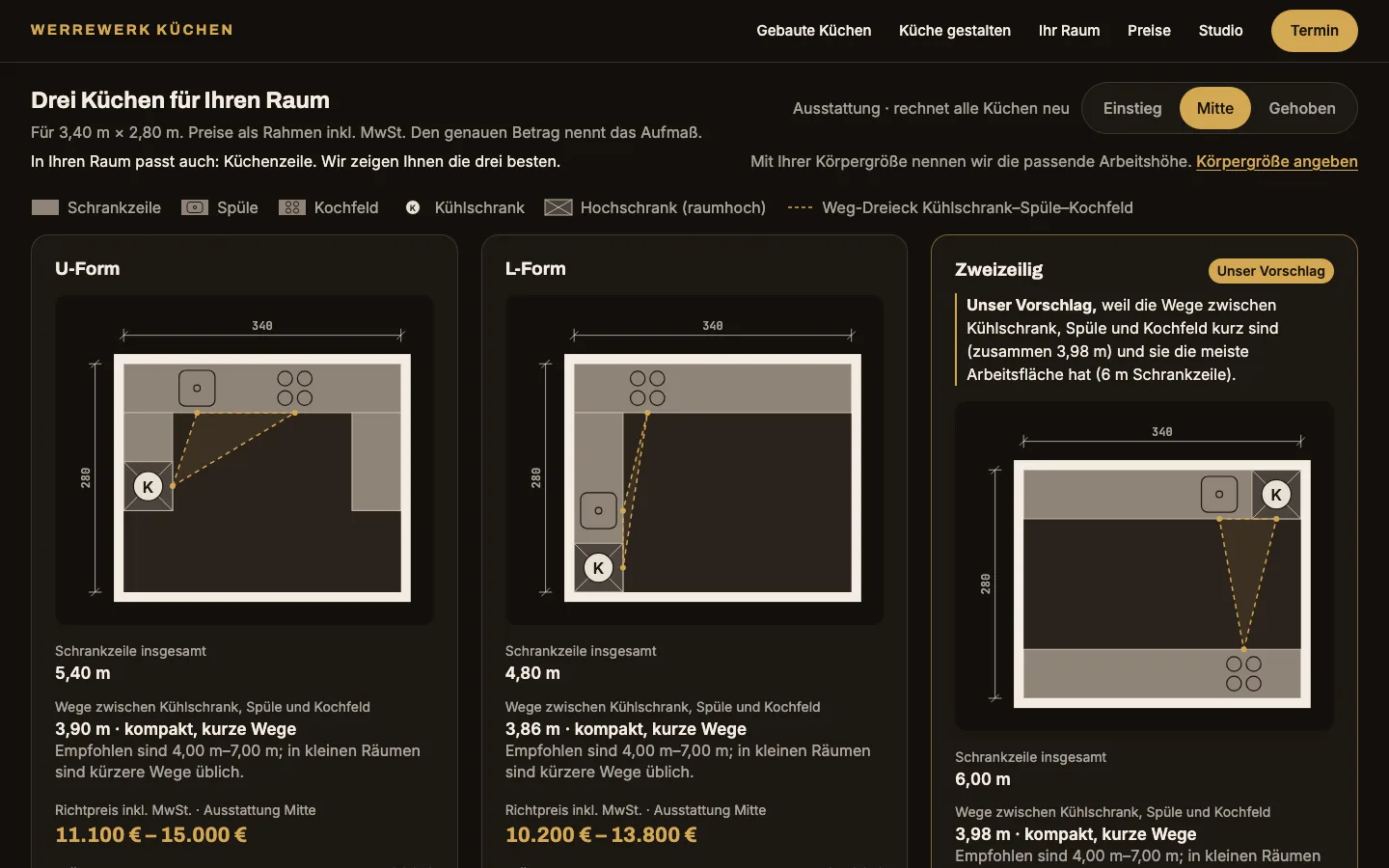
The customer brings their measurements, not a picture from the internet
Under “Your room” the visitor enters the width and depth of their room. The site suggests the three layouts that fit best — such as L, U or two rows — with the work triangle between sink, hob and fridge and a price range broken down into lines. A small pantry gets a suggestion too, not a dead end.
Behind it are rules a planner would use: clearances, working height, material and installation prices we researched and noted with their sources. The site does not give a fixed price; it gives a range and says the exact one comes after measuring.
For you: customers arrive at the appointment with measurements and an idea of the budget, and you start the conversation further along.
→ Three strong features. And still something was wrong.
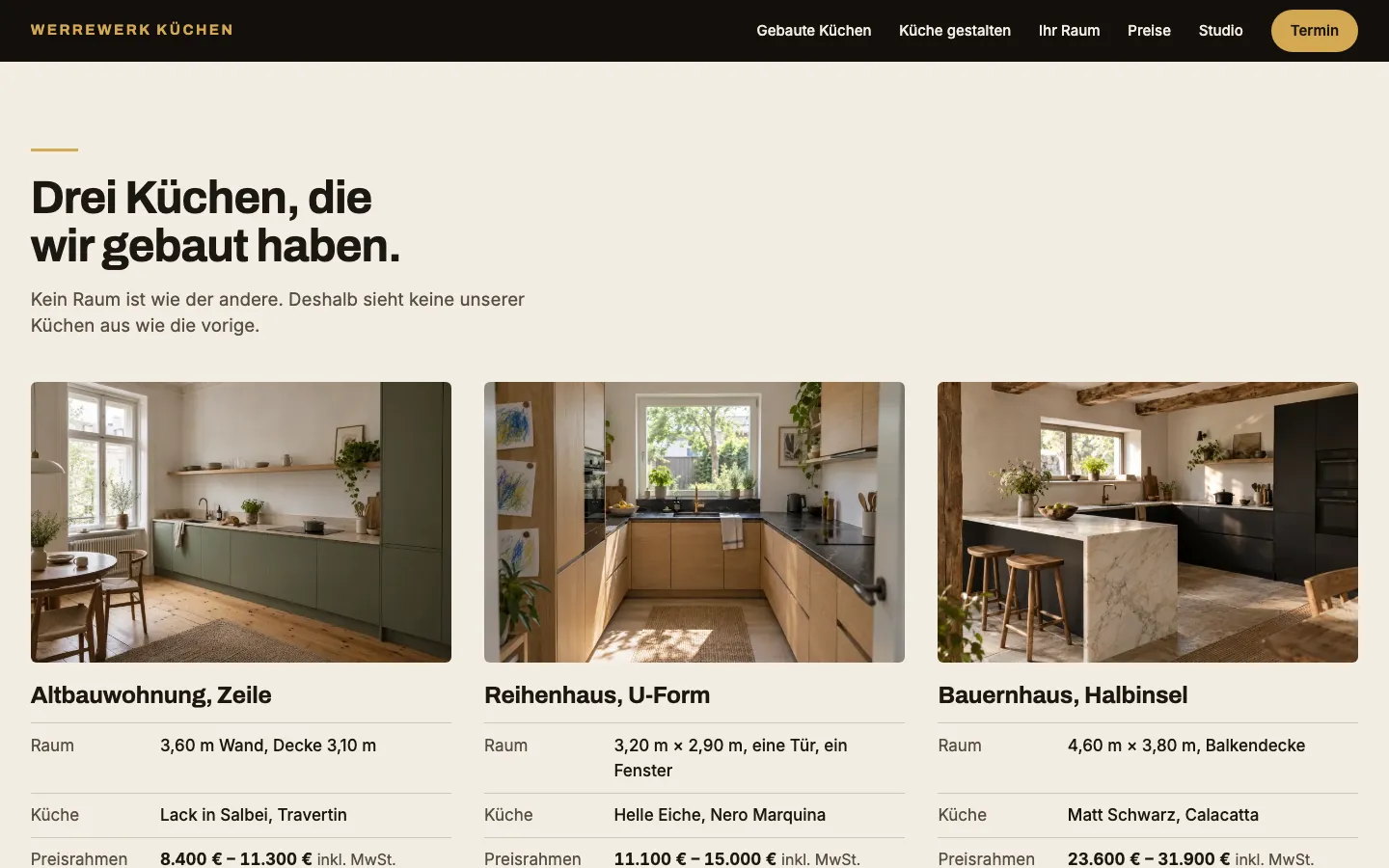
Not a kitchen specialist, but a design draft
On 11 October Ralph looked at the finished site and said: “This is not the site of a kitchen specialist, it's a design draft.” He was right. On the whole site there was exactly one kitchen, the one from the film. Not a word about workshop, showroom or kitchens already built. An outside review gave it 70 of 100.
The features stayed. What came in was the business: three kitchens built in other homes (a galley in an old apartment, a U in a terraced house, a peninsula in a farmhouse), each with size and price range. Craft up close: a stone edge cut on the mitre, fronts with even gaps, dovetailed oak drawers, every wall measured by hand. Six promises, among them the price broken down into lines, a deposit of at most ten per cent, the delivery date in the quote and a joiner who comes back to adjust. And a showroom with opening hours.
Why like this: the visitor must first believe a specialist business, only then do the features carry weight. The same review then gave 82. For you: you already have all of this, your kitchens, your workshop, your promises. It just isn't on your website yet.
The features make people curious. They buy from the business behind them.
→ At the end the site lets the visitor in on the secret.
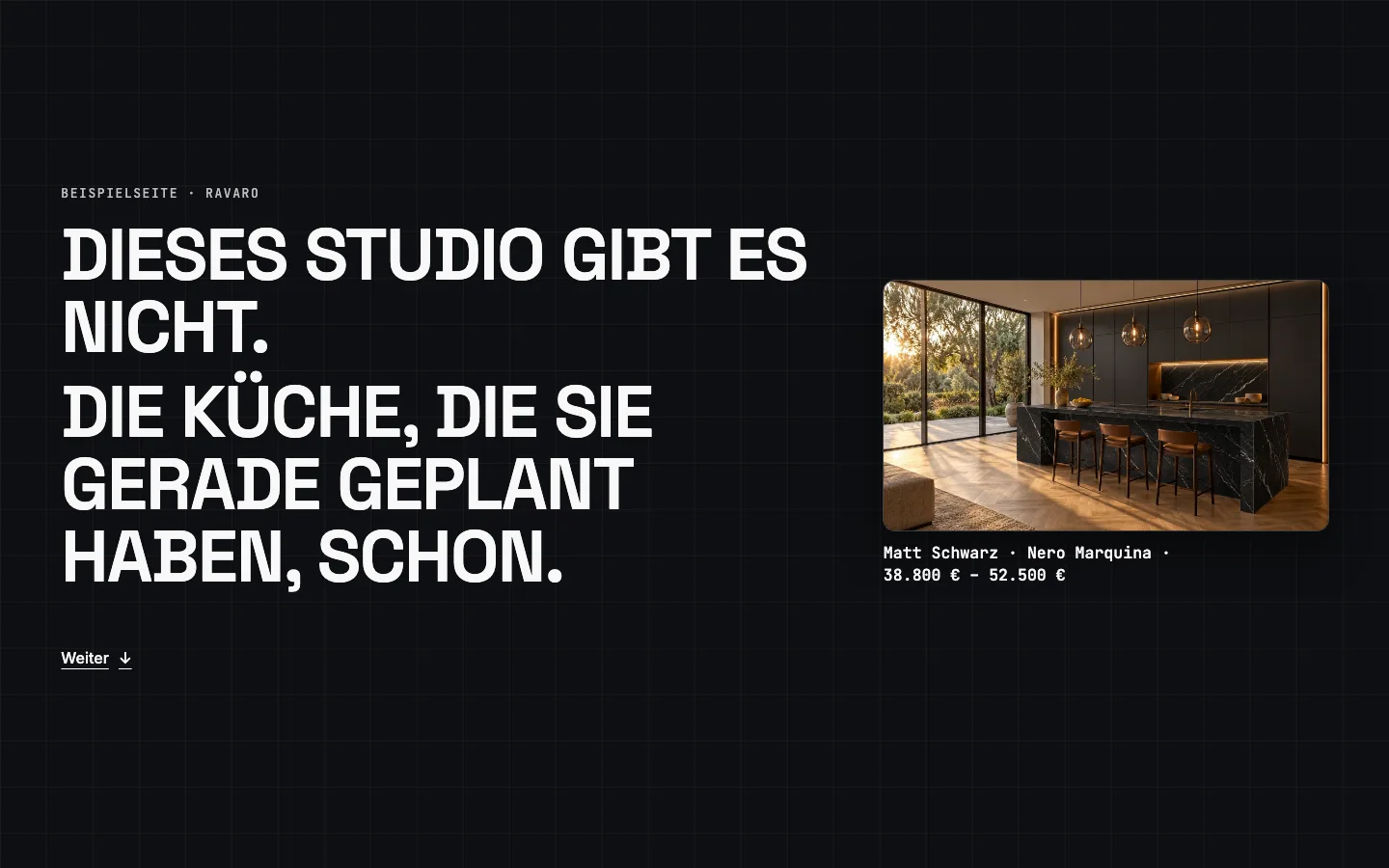
This studio doesn't exist. The kitchen you just planned does.
Whoever arrives at the end wanted to book an appointment a moment ago. That is exactly where the site turns: “This studio doesn't exist.” Since version 0.18 it shows the kitchen the visitor has just designed, with front, stone and price range. Only then does RAVARO appear.
Why like this: the twist works only if the visitor believed the studio up to that point. That is why it comes after the purchase decision, not before. For you, this is the moment your appointment button sits.
→ Whether it works is not something we judge ourselves.
Measured, not estimated
A review that did not build the site checks it with WebGainer, our own scoring tool, from the first impression to the way to the enquiry. The draft without the business scored 70, the version with kitchens, craft and promises 82.
On a phone the published site scores 93 of 100 for speed, and the large picture is in place after 3.0 seconds, although a film plays at the top. Every second of waiting costs visitors before they have seen anything.
Measured
→ The way there was not a straight line.
What went wrong and what we learned from it
- What happened
The first draft showed a paper kitchen clicking itself together piece by piece. Ralph: no wow.
→ What we do differently sinceThe opening shows the result you want to own. How it comes about may carry it, but it ends in the finished kitchen.
- What happened
A kitchen that moved in layers with the mouse looked clean in two still frames and showed cracks while moving.
→ What we do differently sinceMovement is judged as a film, never at two end positions. The layers gave way to a real camera movement around the island.
- What happened
Three strong features, but only one kitchen on the whole site. Ralph: “a design draft”.
→ What we do differently sinceFirst the business, then the features. A showcase is first the complete site of a believable specialist.
- What happened
Night blue turned into a reddish grey in the kitchen, and we had waved it through by eye.
→ What we do differently sinceColours are measured and looked at in the room. Lacquer in a photographed room is colour times light.
Werrewerk Küchen does not exist: studio, kitchens, workshop, showroom and hands were made with AI; the site says so itself at the end and on “About this site”. The guide prices come from a set of rules with researched material and installation prices; they replace no measuring. The form writes to RAVARO, not to a kitchen studio.
Built without a commission, the site shows what is possible; it does not prove a sales figure. The test on a real iPhone is still outstanding.
What this means for your business
The kitchen studio is invented. What is behind it is not: whoever sells made-to-measure work with advice — a kitchen, a bathroom, a wardrobe, a staircase — can let the customer see their piece before it is built, with an honest price range, and show next to it the business they would trust to build it.
That is exactly how we build your website. And you see it before you decide.
A website that only looks nice is dead weight. Website Systems builds a site from your actual business goals — one that takes work off your plate and turns visitors into real enquiries.
MORE CASES ///
Next build

The Next Adventure
What if your visitors remembered your website like a game from their childhood? A host who turns round to look at you, a jungle that grows into the study, twelve stations to play along with — a website you don't read, you play it.

Jade Tempel
What if your guests had already walked the way to you before they set off? 1,284 steps, a hall of jade, a dragon after the storm — a website you don't look at, you climb it.

NEPHELE Residences
Nobody buys the development. They buy apartment A1803.

Leuchtfeuer Nordsee
Four days, ten versions, one lighthouse — and a lens you take apart yourself.

NUIT VISIBLE
A scent cannot be shown. So we let the scroll tell it.

The Elite Cars
A supercar dealer whose website already looked good — and still could not sell a car to someone who didn't feel like driving over.
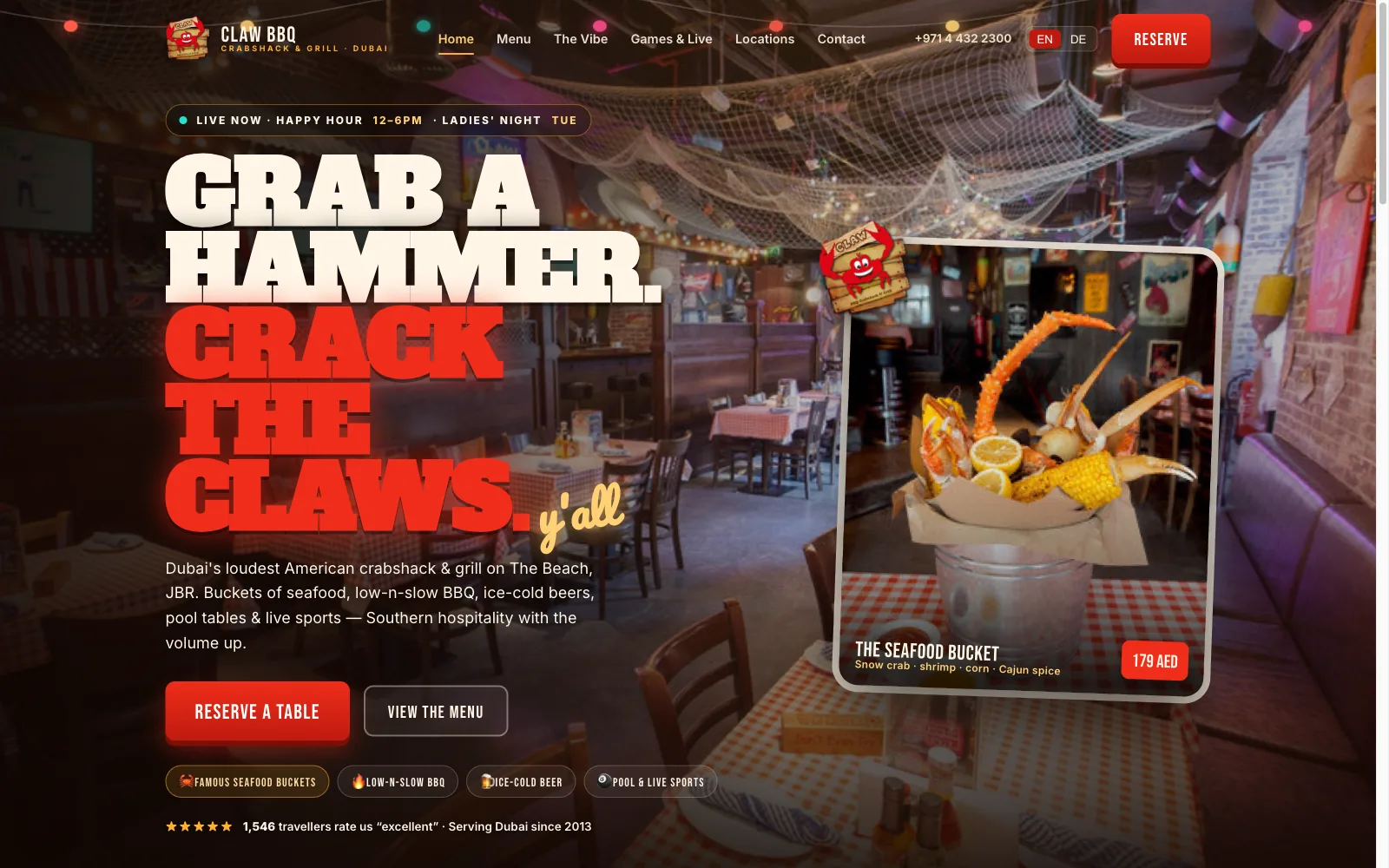
CLAW BBQ
I know this place. Their website did not.

Juwelier Dührkoop
Fine watches, sold from a page you could not lean into.

Andy Engel
A man people fly across continents for, with a website built for people driving past.
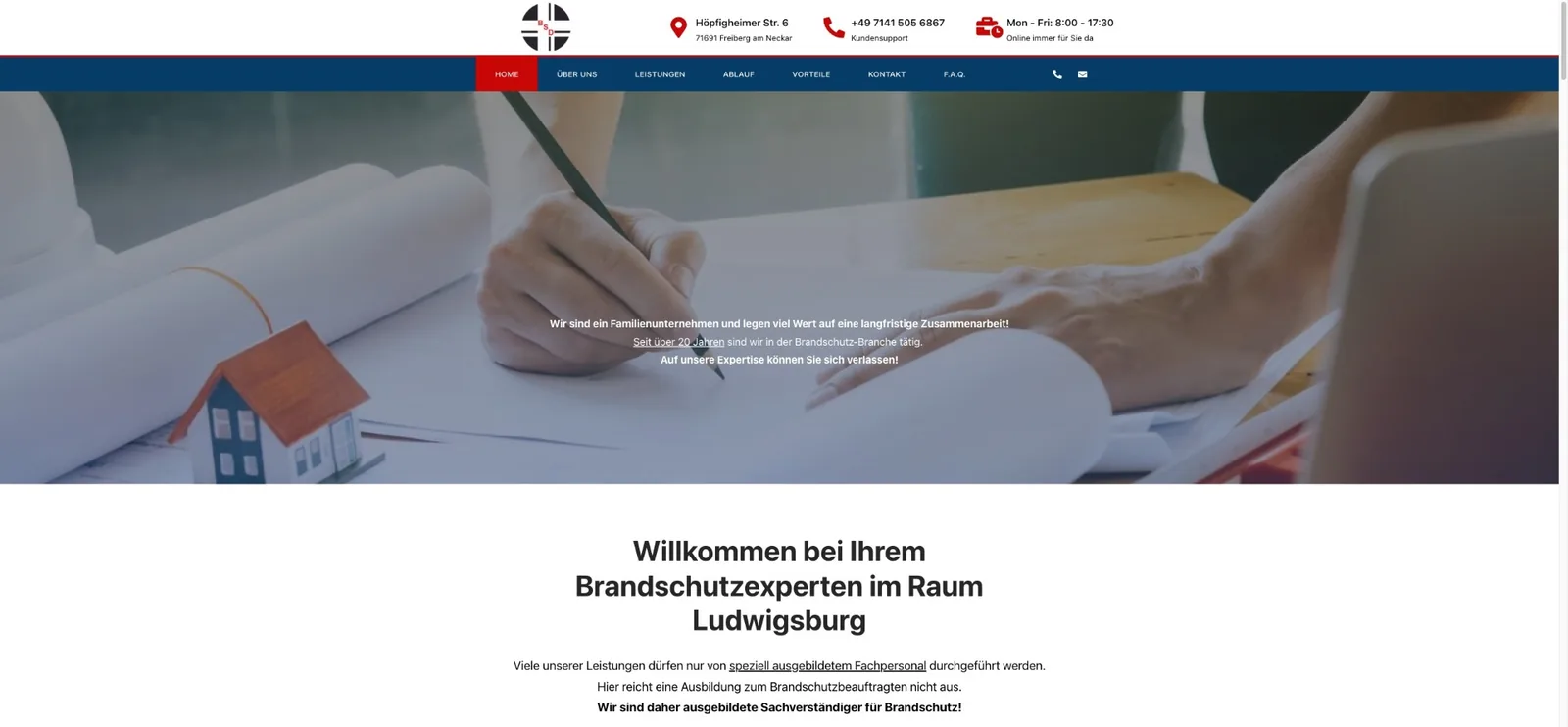
BSD Wiedemann
We stopped his website selling fire extinguishers, so the business could start selling expertise.

Hofmühl
A brewery does not sell beer on its website. It sells the reason someone reaches for that bottle in the shop.
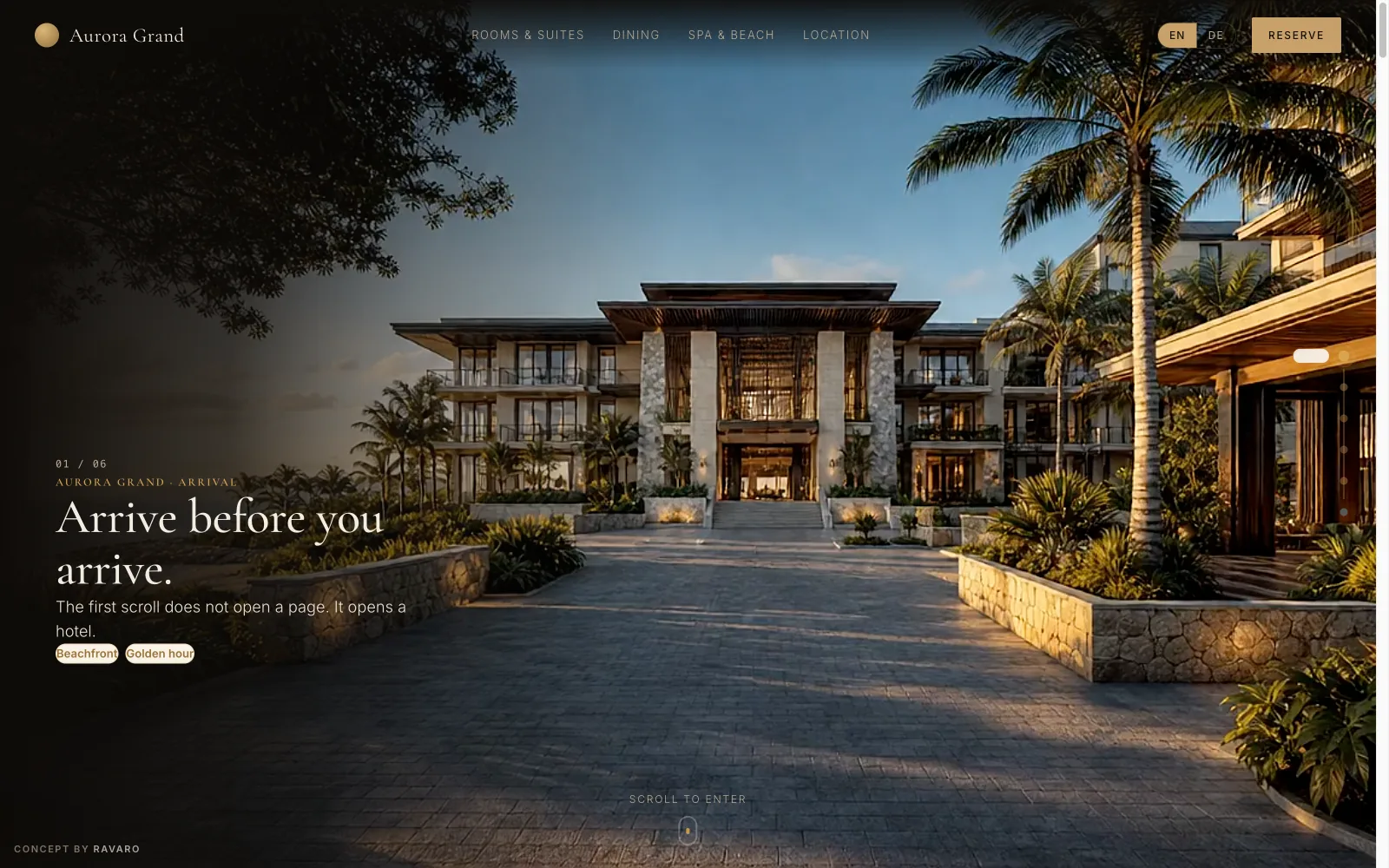
Aurora Grand
A hotel website you walk through before you book.

PULPA
A lemonade that doesn't exist, on a website that does things most websites can't.
All our website work
Every project in this discipline — numbers, videos and results.